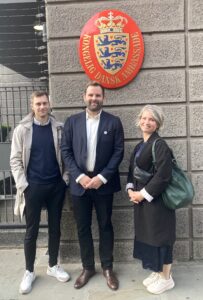
On October 1st the Danish Agriculture and Food Council (DAFC) staged their second roundtable on Ultra Processed Foods (UPFs) in the stunning setting of the Ambassador’s Residence in the Danish Embassy, high above the designer residences of London SW3.
I worked with Cornelius Simonsen of the DAFC to programme the evening and I chaired the eminent panel – Associate Professor Daniel Borch Ibsen (Arhus Univerity), Puk Maia Holm-Sondergaard (DAFC), Kate Halliwell (Food & Drink Federation) and Anthony Warner (Development Chef & Writer). It was a thought-provoking evening, with a wide-ranging discussion that engaged effectively with the seventy-strong audience who were forthright with their opinions.
I had proposed that the title for the evening should be Towards A More Scientific Definition Of Ultra Processed Foods to reflect widespread unease about the way the NOVA classification system is being applied. What became rapidly apparent is that no-one is going to pick up the baton of ‘improving’ NOVA. There was agreement that a more thoughtful view of processed foods would be helpful to all, possibly one that considered nutritional content and degree of processing.
There was agreement amongst the panel and from the audience that any attempt to follow the state of California in attempting to define and proscribe UPFs would be ill advised. The announcement that the World Health Organisation was forming a multi-disciplinary expert group to consider how much UPF should be consumed got a cautious welcome. Although we are not yet able to prove a causal relationship between UPF consumption and ill health we need to keep looking.
There was also a consensus that the enormous amount of attention generated by UPFs and the concern shown by consumers has significantly moved on the conversation about the diet that we eat, and the role of food processing. Many of the consumers who say they are reducing their UPF consumption may not be able to articulate what a UPF is, and they may actually be talking about foods high in fat, sugar and salt (HFSS) but the concern is genuine and needs a coherent response from retailers, suppliers and policy formers (all of whom were in the room).
So a more precise definition of UPFs may be unlikely at present, but that should not stop us from responding to the issues that consumer interest in UPFs has raised.. Denmark has shown just what can be achieved by government intervention, actively promoting organics, fibre-rich foods and a plant-rich diet through partnerships between central government, local administration, manufacturers and retailers.
One welcome development is the possibility of mandatory reporting by major players on the nutritional content of the food that is produced and sold in the UK. The prospect of a legally-enforced level playing field is proving popular with retailers and manufacturers and the data it would generate could prove useful starting point for some diet-based ‘nudging’, another area where the UK can learn from Denmark’s experience.
The DAFC plans to do more work in this area next year, watch this space…